Interactive product preview
Your family and community, in your own words.
Map how people are connected and describe the relationships that matter to you. We’re developing language tools with communities so those connections can be expressed in the words they use themselves.
Demonstration uses entirely fictional people and relationships.
The product moment
Explore a network that reflects real belonging.
Select a person, filter the kinds of ties you want to see, or trace a guided connection across this entirely fictional network.
Tap a person or use Tab and Enter to inspect their ties.
Guided interaction
Trace a connection
Explore a family route, a wider social connection or the personal words someone uses for a tie.
The relevant people and connections will brighten while the rest of the network gently recedes.
Separate language example
The words we use for our relationships
This fixed example shows how Daniel is related to Amara. Try the small demonstration vocabulary below. Broader language coverage and cultural usage are still being developed with community review.
Daniel is Amara’s father
A demonstration vocabulary. Dialect, spelling and wider relationship coverage remain subject to community review. This example is independent of the selected map route.
Why it matters
Every relationship has a place. Every community has its words.
- 01
People define their own circles.
Chosen family, elders, mentors and community bonds deserve a clear place alongside relatives.
- 02
Relationship words carry meaning.
The way we describe someone can reflect care, culture, place and generation. Families need room for that context.
- 03
Language knowledge can be shared.
Family and social vocabulary offers a familiar starting point for communities building digital resources in their languages.
How it works
Begin with the people. Let the relationships tell the story.
- 1
Add the people who matter
Start with a name, then build the record at your own pace.
- 2
Define relationships in the terms that fit
Record inherited, marital, chosen and community ties without ranking their importance.
- 3
Explore how everyone is connected
Move through the network, focus on a person and reveal routes across the wider family.
Planned language bank
A shared resource, shaped by speakers.
We’re planning a place for speakers to document relationship terms together, starting with family and social connections. This is a first contribution to languages with limited digital support.
Contribute a term and its context
Describe who uses it, what it means and when it fits. Voice examples are a future possibility for spoken usage.
Invite review across groups
Speakers from participating families and communities can say whether they recognise a usage, suggest a change or say they do not know it.
Keep room for differences
Alternative meanings, spellings and dialects can sit alongside each other. A personal family description remains the choice of the people using it.
Product in motion
A working MVP, shown as it is today.
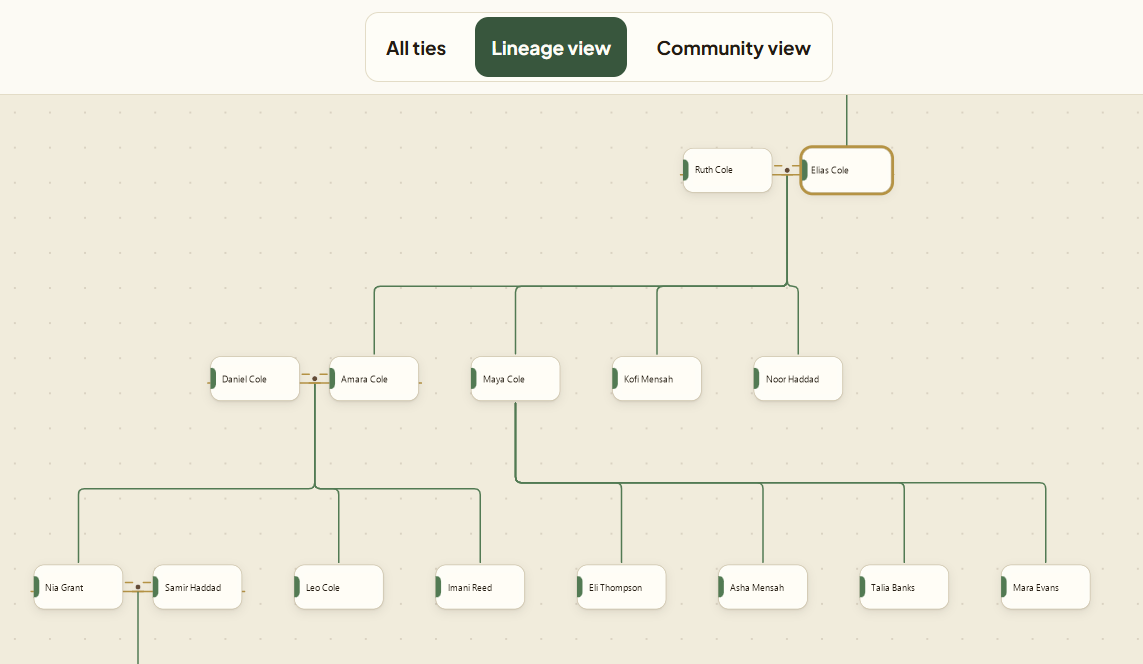
These current screens show today’s dashboard, 2D map, person record and relationship-composer experiences. Identifying labels have been replaced with fictional demonstration data.
2D relationship map
The working 2D view separates lineage and community layers while keeping both visible as meaningful parts of the wider network.
Product status
Where the product stands
Follow My Roots has a working relationship-mapping MVP. This public preview lets you explore a fictional sample network and a small demonstration vocabulary while the product is prepared for closed pilot testing.
- Implemented
- Person records, relationship records, tree dashboard, 2D map and bounded 3D exploration.
- Active refinement
- Dense-graph readability, mobile ergonomics, accessibility, GEDCOM confidence and cultural review.
- Under development
- Multilingual kinship labelling and real-time multi-user collaboration.
- Planned
- A shared language bank with optional contributions, review across community groups and visible language variants.
Community pilots and partnerships
Build the next chapter with your community.
We’re seeking diaspora associations and community networks for initial pilots, with families and speakers helping shape the experience.
- Community organisations
- Explore member access and supported onboarding. Pilot participation will help us test what works and how an organisation subscription could be packaged.
- NGOs and public institutions
- Discuss a facilitated programme with local community partners, helping families document their connections and the language they use.
- Technology partners
- Explore future integrations or sponsorship of community programmes. These are partnership proposals, with scope to be developed together.
Founder-led
Built from lived diaspora experience
Founder Jamal Bangura created Follow My Roots from his own experience of tracing family across cultures. He built the MVP to help people map their living connections and keep the language and understanding that give those relationships meaning.